
The Thema Mundi: The Birth Chart of the Universe
One of the most foundational pieces of astrological tradition is the Thema Mundi, the mythic chart of the creation of the universe. Thema mundi, which translates literally to ‘world theme’, is the Latin transliteration of the Greek, ‘kosmou genesis’, meaning beginning of the universe. The Thema Mundi is the theoretic birth chart of the universe that illustrates harmonic order of the planets situated in their domiciles, providing an arrangement that acts as a teaching tool for the most fundamental concepts that astrology is constructed around. In his work, Mathesis, Firmicus Maternus states, “The divine wise men of old invented this birthchart of the universe so that it would be an example for astrologers to follow in the charts of men.” Maternus goes on to describe the Thema Mundi, and claimed to have adopted from the famed but mysterious Nechepso and Petosiris. It has also been traced back to the mythical Hermes Trismegistus, and is mentioned by Thrasyllus in his lost work, Pinax, that has been summarized and referenced by subsequent astrologers. Regardless of its initial conception or earliest mentioned, based on extant texts, we can surmise that the Thema Mundi was a well-known horoscope transmitted throughout late antiquity that astrologers would have been intimately familiar with.
The Thema Mundi chart places each of the planets in sequence at 15° in their domicile signs, starting with the Moon in Cancer, the Sun in Leo, Mercury in Virgo, Venus in Libra, Mars in Scorpio, Jupiter in Sagittarius, and Saturn in Capricorn, as well as the ascendant at 15° Cancer, exactly conjunct the Moon. While the arrangement of the planets in these exact degrees is astronomically impossible, as Mercury is never more than 27.8° from the Sun and Venus is never more than 47.8° from the Sun, it does illustrate that that Mercury is never more than one sign away from the Sun while Venus is never more than two signs away from the Sun. Additionally, this chart illustrates the planets in Chaldean order, an ancient arrangement of the planets in an order that reflects their relative speeds they move across our sky from slowest to fastest: Saturn, Jupiter, Mars, Venus, Mercury, the Sun, and finally, the Moon.
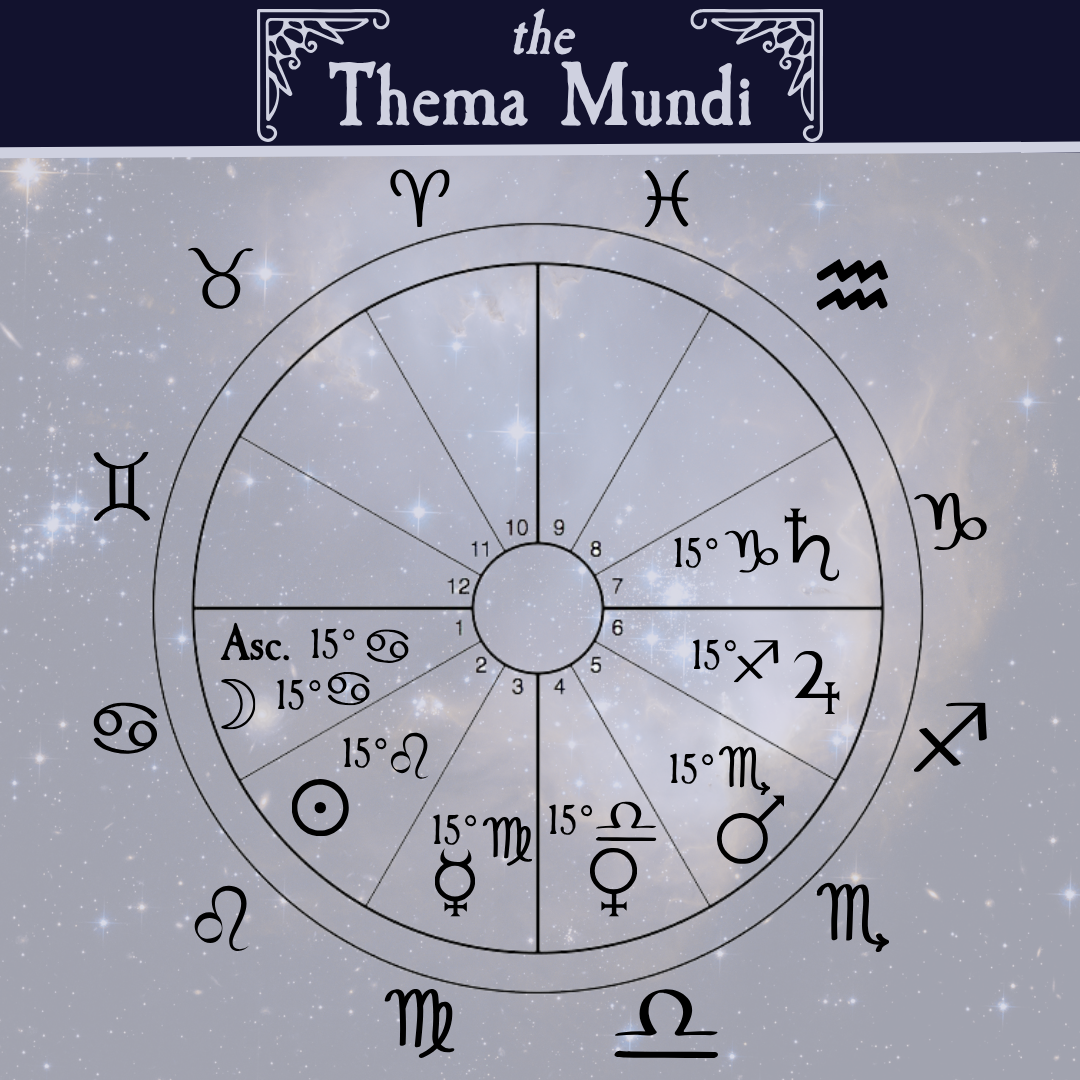
Image: Depiction of the Thema Mundi, birth chart of the world
As previously mentioned, one of the first things to note about the Thema Mundi is the placement of each planet in their own sign of domicile. The Thema Mundi itself is considered to provide the conceptual basis for the domicile placements. Our luminaries are situated in Cancer and Leo, the two warmest zodiacal seasons that provide the most day light. The Moon, our nocturnal luminary, aligns with the nature of Cancer, a nocturnal and feminine sign, while the Sun, our diurnal luminary, aligns with the nature of Leo, a diurnal, masculine sign. From here, as we progress through the planets and make our way to cold the seasons descend from the vibrant life of Summer into the frigid depths of winter as we end with cold, distant Saturn. What’s further, when we mirror this scheme onto other half of the zodiac, the planetary rulers sit in the same order flanking out from the Moon.
Domicile Scheme and Aspects
From here we can begin to deduce meaning of planetary aspects by looking at the ordering of the planets in relation to the luminaries.
As the ‘greater malefic’ Saturn sits in opposition to the Moon, with both in feminine signs. As Saturn makes his ingress into his Masculine domicile, Aquarius, and opposes the Sun whose home sign of Leo is masculine. This situates Saturn in opposition to both luminaries, and oppositions are said to be of the nature of Saturn and the most difficult aspect.
When Jupiter is at home in masculine Sagittarius, as in the Thema Mundi, he aspects the Sun by trine and relates himself to the condition of the Sun. When in his feminine domicile sign, Pisces, Jupiter trines the Moon at home in Cancer. Jupiter is the ‘greater benefic’, and trines the most benefic aspect, said to be of the nature of Jupiter.
In the Thema Mundi Mars is in his feminine domicile, Scorpio, placing him in a trine to the Moon but a square to the Sun. When at home in masculine Aries this aspect pattern is reversed, relating to the Sun via a trine, while squaring the Moon in her feminine sign. Mars is considered the ‘lesser malefic’, and squares are a challenging aspect that present the potential to overcome difficulty with triumph, reflective of the competitive, forceful nature of Mars.
In the Thema Mundi Venus is in her masculine domicile sign of Libra, squaring the Moon in feminine Cancer, but sextiling the Sun in masculine Leo. In her feminine home sign of Taurus, Venus sextiles the domicile of the Moon while Squaring the Sun. Venus is the ‘lesser benefic’, and sextile aspects are said to be of the nature of Venus, positive yet less positive than trines.
Finally, Mercury is in its feminine domicile of Virgo, sitting in aversion to the Sun, who Mercury never strays far from, while making a supportive sextile to the Moon. In the arrangement of the Thema Mundi Mercury would be in its evening star phase, rising after the Sun and visible in the sky just after sunset, reflective of the supportive aspect to the Moon. In Mercury’s masculine domicile, Gemini, Mercury is in aversion to the Moon and sextiles the Sun. Placed in Gemini in relation to a domicile Sun, Mercury would be in its morning star phase, visible at the eastern horizon just before the Sun rises, resonant with a supportive aspect to the Sun.
Why the ascendant is in Cancer
There isn’t really much surviving textual evidence as to why the Thema Mundi was constructed with a Cancer ascendant (if I’m mistaken on that, or if you’re seeing this at a time when newly translated resources provide more context, I’d LOVE to hear about that in the comments!) However, in considering the progression of the seasons and established astrological doctrine, Cancer initiates us into Summer, the hottest season of the year best known for the flourishing of life and abundant growth in nature. We can also find strong correlation to the Egyptian calendar and seasonal observation, as the Nile would flood annually at the heliacal rising of the fixed star Sirius, who sits at 15° Cancer. The flooding of the Nile marked the beginning of the Egyptian year, thus, making 15° Cancer an important place of beginning.
The ascendant holds tremendous significance and was viewed by the ancients as representing the moment the soul incarnates. As the very beginning of the chart, the ascendant sets up the chart’s structure and lays the groundwork for the natal promise that will unfold. Our earth nurtures the existence of life, and the Earth is the mother of all humanity, serving as a guide to our evolution through her resources, abundance, and seasonal cycles. Ancient cosmology views the sub-lunar realm that contains earth as the place where all matter is comprised of the four elements. Within this constitution (and the literal constitution of the Earth itself, water is essential to the very existence of life. We, as individual humans, even mirror this by emerging from the waters of the womb. Therefore, water serves as the very beginning of life, necessitating a water sign on the ascendant. Of the three water signs, Cancer is the most apt for the job because of its cardinal nature, its ability to initiate and set forth new beginnings. What’s further, this positioning grants a midheaven in Aries, creating a chart where the Sun exalts at its zenith at the very top of the chart.
Firmicus Maternus opens this portion of Mathesis with an eloquent statement on the relationship between the human form and the universe, and the very principles that govern our own birth charts, essentially giving way for the rules that dictate the building blocks of astrology. Just as our natal charts act as our own cosmic talismans that delineate our natal promise, the Thema Mundi acts as a talisman of the art of astrology and its relation to cosmic resonance. And because I could never put it better than the ancients themselves, I will leave you with a quote from the introduction to book three of the Mathesis:
‘we must be aware that god the Creator, copying nature, has made man in the image of the universe, a mixture of four elements-fire, water, air, and earth-so that a well-proportioned combination might produce the living being as a divine imitation. With his divine skill he so composed man that the whole force and essence of the elements is collected in that small body. In this way he prepared a lodging for the divine spirit which descends from the heavenly Soul to maintain the mortal body. This spirit, though fragile, is nevertheless a likeness of the spirit of the Universe. Thus man, like a tiny universe, is sustained by the everlasting fiery movement of the five planets and the Sun and Moon…Petosiris and Nechepso, who approached the very secrets of divinity, also handed down to us the birth chart of the universe in order to show us that man is made in the likeness of the universe according to those same principles by which the universe itself is ruled; and that he is sustained forever by those everlasting fires.’