
Planetary Joys
Just as the planets have preferences for certain signs, they also have a particular house they hold preference to. This sector of the chart is considered to be where the planet has their joy. Not only does the scheme of planetary joy lend dignity to the planet, referred to as accidental dignity (as opposed to essential dignity), but it also points us to an essential part of the origination to the house significations. The planetary joys are reflected in the traditional names attributed to each house as well. This article will give a brief overview the scheme of planetary joys and explore the various ways in which this scheme serves as a reflection of some of the most fundamental building blocks of astrological technique.
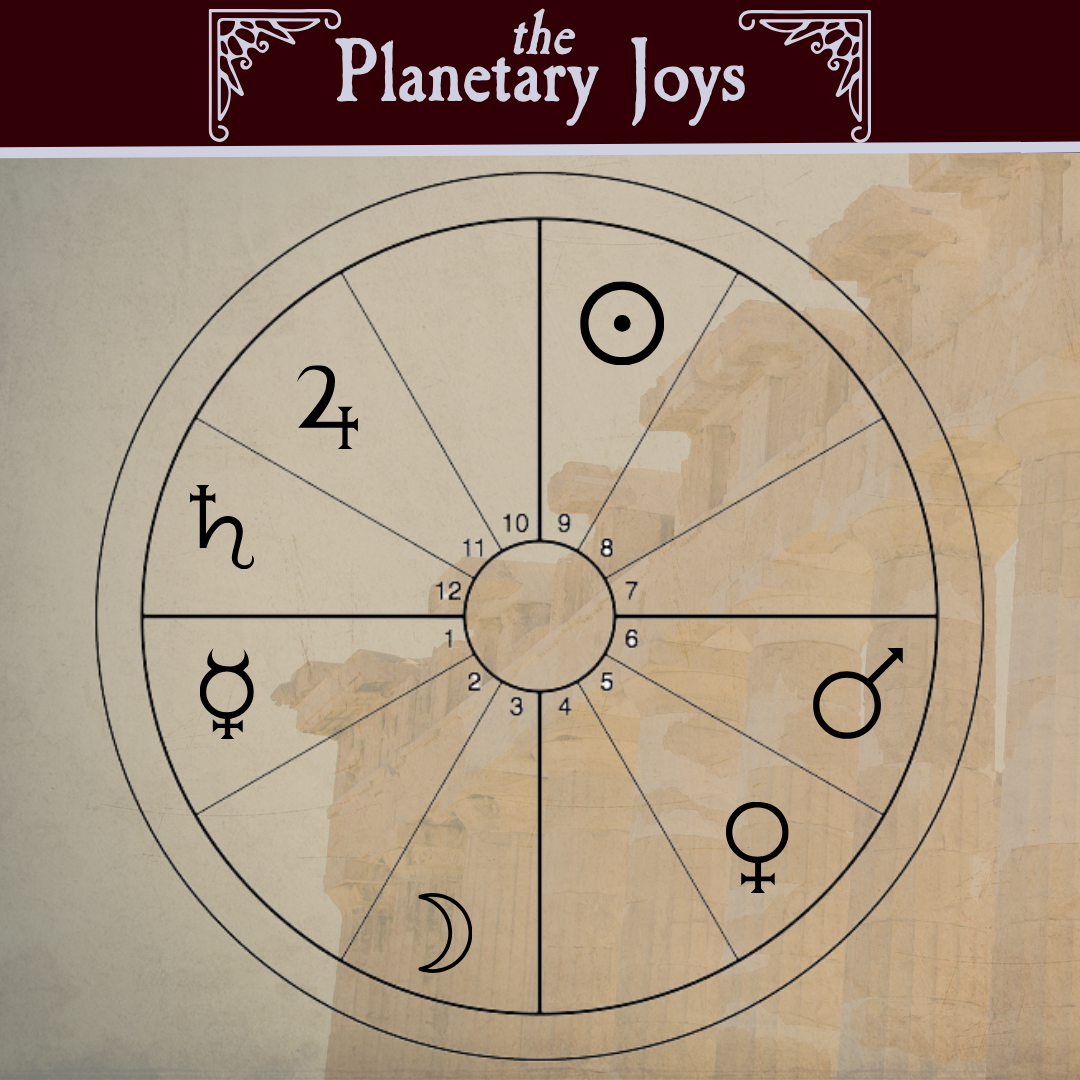
This scheme holds significance in illustrating the fundamentals of sect through placing each planet in alignment and in the appropriate hemisphere of the chart respective to their sect.
The Sun, Jupiter, and Saturn, the planets comprising the day sect, all rejoice in houses of the upper hemisphere of the chart, above the horizon line that falls across the first and seventh houses. Even further, when considering the topics of the houses, that in the upper hemisphere hold association with matters of spirit, or daimōn, that which we pursue, and is considered to be the realm of the Sun.
The Moon, Venus and Mars, planets of the night sect, all rejoice in the lower hemisphere of the chart, below the horizon. The houses in the lower hemisphere of the chart are concerned with matters of fortune, or tuchē, matters of physical incarnation, the body, and circumstance, and belong to the realm of the Moon.
Mercury, on the other hand, rejoices in the first house. In the whole sign house system, the first and seventh houses are the houses that straddle the hemisphere line, as the ascendant-descendant line crosses through these houses with the entire sign occupying the house itself. This composition grants us a system that places these houses as straddling two worlds—our terrestrial realm and the celestial realm of the skies above. Mercury is the only planet that holds the ability to belong to either sect depending on its positioning in relation to the other planets, and placing it in this changeable space is reflective of Mercury’s own mutable nature.
We see meaning of the aspects present as well, with each luminary configured to the malefics by square, a difficult aspect, and configured to the benefics by positive aspect. Both luminaries sit in a square to both malefics, while sitting in sextile to their respective benefic of sect and trining the benefic contrary to sect. For the Sun this means sextiling Jupiter while trining Venus, and the Moon sextiles Venus while trining Jupiter. Additionally, Mercury makes positive aspect to both luminaries, sextiling the Moon while trining the Sun.
The Luminaries: God and Goddess
The Moon bestows the third house its traditional name, Thea, or Goddess. Manilius described this place as ‘the temple of the Moon’. Many of the traditional significations of the third house are imparted by the motion and characteristics of the Moon, such as quick journeys, religious rites and sacred observances, and even the signification of siblings comes from the ancient view of the Sun and Moon as divine siblings that personify the lights of the skies.
In juxtaposition, the Sun grants the ninth house its traditional name, Theos, or God. In the diurnal motion of the Sun the ninth house would be where the Sun slopes down from the midheaven, and would be the space in the sky that the Sun occupied at the brightest, hottest part of the day just after the Sun was directly overhead. The ninth house deals with themes of religion, faith, wisdom, pilgrimage, and divination, and it is of the nature of the Sun to illuminate, reveal, impart enlightenment, and see everything, resonating with the underlying meaning of ninth house themes tying to concepts of broad worldviews, illumination and revelation, and seeking greater meaning and understanding.
The Benefics: Good Fortune and Good Daimon
The benefics align with the two most positive, non-angular houses and bestow the traditional names to their respective houses through their beneficence. The fifth house falls in the nocturnal hemisphere of the chart that deals with the body and circumstances bestowed upon us, and gains its traditional name, ‘Good Fortune’ from Venus, the nocturnal benefic of sect. The fifth house configures to the ascendant by a supportive trine, and the core signification of the fifth house is children, who historically are considered to be blessings and a means of continuing the family line, an extension of the native signified by the first house. The fifth house gained these significations through its connection to Venus, who signifies the sensual experience through which we engage the pleasures of life and stimulate the act of procreation (historically, having children, but in a modern context can be applied to the desire to create)
The eleventh house is where Jupiter finds its joy, and in a similar convention to the fifth house, grants this place the name, ‘Good Daimon’. The eleventh house is located in the diurnal hemisphere, the hemisphere associated with pursuit of the soul. This house rises up towards the peak of the skies at the midheaven through the diurnal motion of the Sun, aligning this space in the chart with aspirations, the individual’s motivations, and the pursuit of success. This house is configured to the ascendant by a positive, superior sextile. Thus, Jupiter, the diurnal benefic, grants its positive significations and benefic notions onto this house.
The Malefics: Bad Fortune and Bad Daimon
In symmetry with the two benefic houses, Mars and Saturn, the two malefics, impart signification on the houses considered to align with misfortune and ‘bad’ significations in their respective hemispheres of the chart. Mars, the malefic of the nocturnal sect, rejoices in the sixth house, which sits below the horizon line and in aversion to the ascendant. The sixth house is cadent and declines from an angle, sloping downward just after the place where the Sun sets. This set of circumstances lends to the ineffectual nature of this house, and makes it a place where planets tend to struggle in their ability to support and sustain life force. The sixth house is associated with illness and bodily harm, and Manilius likens this to the war-like nature of Mars by pointing out, ‘the changes in our health and the warfare waged by the unseen weapons of disease.’ While the first house serves as a representative for the health and vitality of the native, the averse sixth house denotes illness, disease, and injury that can compromise the vitality of the native, as well as the everyday obligations of toil and work that often wear down our vitality (both literally, such as through manual labor, and figuratively, as in the mundanity of life obligations that become exhausting, especially under capitalism).
The twelfth house sits in aversion to the ascendant, just above the horizon line, and is where our diurnal malefic, Saturn, finds its joy. This scheme of bad and good daimon is symmetrical to our place of good and bad fortune, with our two malefics finding ‘joy’ across from one another and next to their sect-respective benefic, just as our benefics rejoice across from one another and next to their respective malefic of sect. According to Manilius this house is, ‘a portal of toil in which you are doomed to climb’, and is considered to be the place where the fetus hovers between life and death just before birth, and this would be the sign on the ascendant during labor before an individual entered the earthly realm. Given the perilous nature of labor and childbirth, particularly in antiquity, this alone imparts a severe and ominous nature onto this house. The most standard and enduring signification of the twelfth house is enemies, in juxtaposition to the friends of the house of Good Daimon, and the instability of this house lends towards the vulnerability of suffering and loss. Saturn’s rejoicing here lends towards these themes of alienation, isolation, and melancholy.
Mercury: the Psychopomp at the Helm
As previously touched upon, Mercury rejoices in the first house, the house that signifies the native themselves. This house was traditionally called Hōroskopos, meaning ‘hour marker’, with the sign dwelling in this house being the sign coming over the eastern horizon at the entrance of the native into this terrestrial realm, and the exact degree of the ascendant marking the exact moment of birth. This place was also referred to as the oiax—the helm or steering wheel of a ship, resonant with the first house as the means of how we steer our own lives towards our destiny. The first house brings together the spirit and the body, as the body grants the spirit a vessel through which we take action and manifest our thoughts and words into the world around us. Mercury bridges the realms of soul and body, and in mythology, Hermes carried the ability to travel through realms freely, from the celestial domain of the gods to acting as the psychopomp escort of souls into the underworld. Rhetorius states, ‘the star of Hermes rejoices when it is present in the first house because the divine spirit takes form through the word.’