
Sect
Sect is a fundamental scheme of astrology that provides a foundational basis for how nearly all astrological doctrine operates, including determining which planets will act most favorably and be the most challenging in a given natal chart, how and where each planet functions most optimally and naturally in various schematics of dignity, and even how to approach certain timing techniques from a technical standpoint. The original greek term is hairesis, meaning choice or selection, meant to identify one’s intellectual ‘choice’ and was used for a school of thought in philosophy or medicine. Sect refers to the division of the seven traditional planets into two teams or factions—the diurnal sect, or day team, and the nocturnal sect, the night team.
Both sects are comprised three planets each—a luminary acting as the ‘sect leader’, a benefic of sect, and a malefic of sect. The diurnal sect is led by the Sun, with Jupiter acting as the sect benefic and Saturn as the sect malefic. The nocturnal sect is led by the Moon, with Venus acting as the sect benefic and Mars as the sect malefic. We’ll explore why the sects configure the way they do shortly. As aligned with Mercury’s own changeable nature, Mercury does not have a designated sect, but rather joins a sect based on the factors of its placement in a given chart. Traditional sources have varying views as to what determines the sect Mercury is assigned to in a given chart. Ptolemy and Porphyry both designate Mercury to the diurnal sect when rising before the Sun as a morning star, and the nocturnal sect when in its evening star phase. Valens, on the other hand, assigns Mercury to the respective sect that rules the bounds that Mercury falls within. Others simply assign Mercury to the sect of the chart itself, regardless of Mercury’s own positioning.
A chart’s sect is simply determined by the positioning of the Sun in the sky at the time of birth. As the ascendant-descendant line represents the horizon, when the Sun is above the horizon line, in the upper hemisphere of the chart, the native has a day chart. If the native’s Sun is positioned below the horizon line, they have a night chart. In even simpler terms, if a person is born in the day time, they have a day chart, and a person born at night has a night chart.
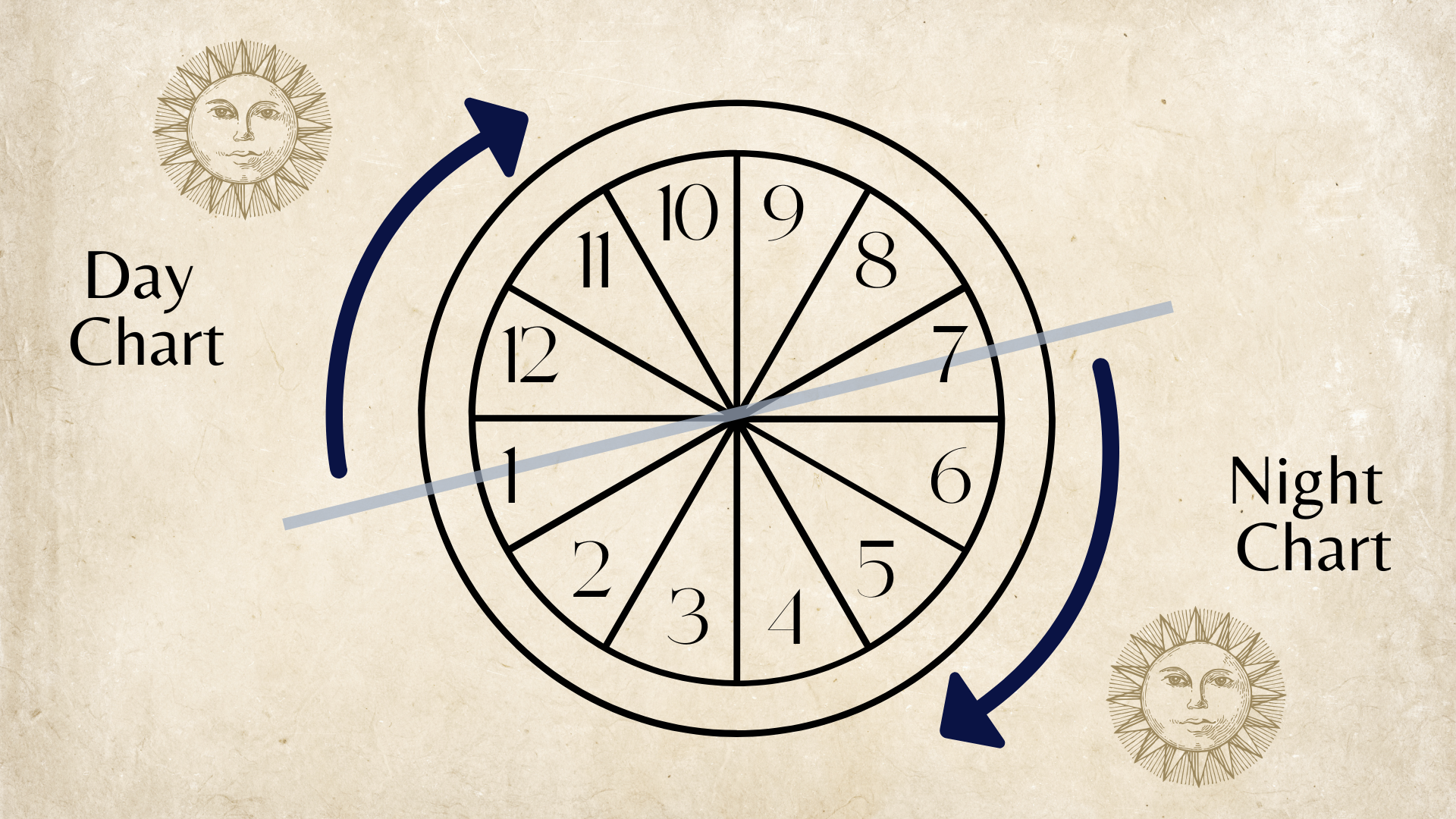
image depicting a sample chart, emphasizing the ascendant-descendant line, indicating that a day chart has the sun in the upper hemisphere and a night chart has the sun in the lower hemisphere
There is some ambiguity when it comes to twilight charts that fall right around sunrise or sunset, as the sky lightens before the Sun actually comes up over the horizon in the morning, and the sky doesn’t immediately darken right when the Sun sets at dusk either. As such, sometimes when the Sun is a few degrees below the ascendant or descendant, it is worth considering whether the chart best functions as a day chart or a night chart. There are varying views on this, with some siting that a chart just before sunrise is more likely to work as a day chart as the Sun is culminating and gaining strength in the sky, whereas just after sunset the Sun is already declining, and therefore the chart works as a night chart. With no extant translated ancient texts, the topic of twilight charts remains an interesting area of debate and research. As with all aspects of natal astrology, one should consider their lived experience and determine what makes the most sense for them, particularly by looking at timing techniques such as zodiacal releasing and considering major milestone and life events in tandem with these techniques. As the owner of a sunset chart, I find this topic particularly interesting, and would love to hear from you if you also have a twilight chart!
Traditional sources designate varying reasons for the configurations of each of the two sects, with temperament and qualities, gender, planetary motion and power, and each of them provide compelling perspectives and frameworks to view the concept of sect, how it works, and why it works.
The Diurnal Sect
The diurnal sect is comprised of the Sun, Jupiter, and Saturn. Naturally, the Sun serves as the leader of the diurnal sect as it is the light that illuminates daytime. In accordance with viewing the planets through the lens of temperament and quality, the Sun is heating and drying. Jupiter also warms, but is moistening, thus Jupiter aligns with the Sun and daytime through its warming qualities, but provides a quality that counteracts excessive dryness. Saturn, a cold planet, is assigned to the day sect because the warmth of day tampers Saturn’s coldness and ability to inflict its malefic nature through its qualities. Porphyry, on the other hand, specifically assigns planets to sect based on speed, designating Jupiter and Saturn, the slower planets, alongside the slower luminary.
The Nocturnal Sect
The nocturnal sect is comprised of the Moon, our light of the night, Venus, and Mars. Much like the warmth of daytime tampers Saturn’s coldness, the maleficence of Mars is counteracted by placing it in the night sect, as the night’s moisture and cooling nature balances the excessive heat and dryness of Mars. In viewing the planets through the lens of gender, the Moon and Venus are the two traditionally feminine planets, justifying their assignment in sect together. In Porphyry’s rationale of designating sect by planetary speed, he designates Mars and Venus, the faster two planets, with the faster luminary.
Sect Functioning in the Natal Chart
As previously mentioned, sect creates a spectrum of beneficence and maleficence amongst the seven traditional planets in any given chart, with each planet preferring to be in a chart of its own sect. Benefic planets act the most beneficially when in a chart of their sect, having their most positive attributes emphasized and easily expressed, while a malefic in a chart of its preferred sect will have its maleficence tampered, mitigating that malefic’s harshness. On the other hand, a benefic in a chart contrary to sect will still be benefic, but won’t act quite as strongly, while a malefic in a chart contrary to sect will have its malefic nature emphasized for that native. With this in mind, in a day chart, Jupiter, the diurnal benefic will act as the most positive planet, while Mars, the malefic contrary to sect, will be the most challenging planet. Venus will still be benefic, but will be inclined to act more moderately and not impart its positive significations quite as easily, and Saturn, while still a malefic, acts much more moderately. On the other hand, in a night chart Venus will be the most positive planet and Saturn will be the most challenging planet, with Jupiter and Mars acting more moderately within that spectrum.
Additionally, planets of each sect hold a preference to the hemisphere of the chart aligned with their respective time of day. In other words, Jupiter, the Sun, and Saturn all prefer to be in the upper hemisphere (above the ascendant-descendant line) in a day chart, placing them in the sky at daytime, and below the horizon at night. The Moon, Venus, and Mars prefer to be in the upper hemisphere of a night chart, placing them above in the night sky, and below the horizon in the day.